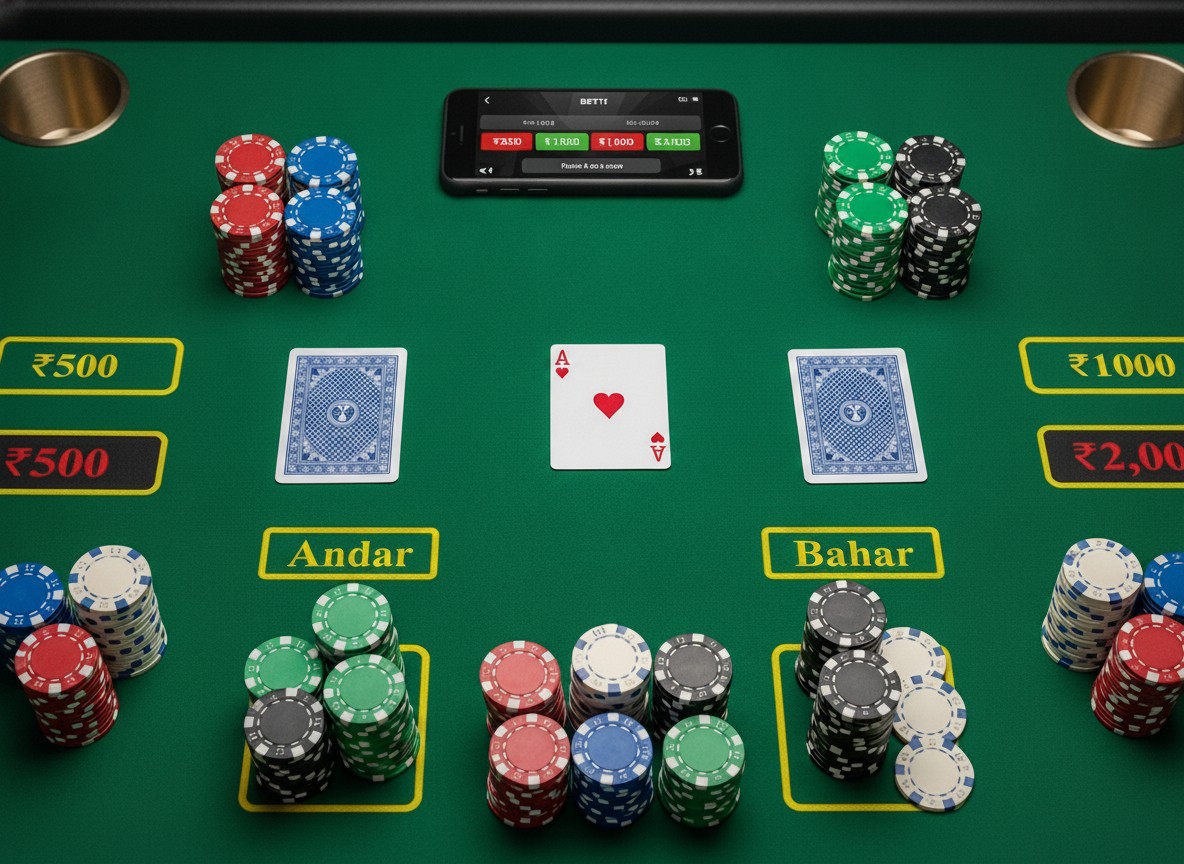
Andar Bahar is one of India’s fastest and most beloved card games, blending simplicity with exciting real-money potential. Unlike skill-intensive games such as poker, Andar Bahar revolves around chance, odds, and disciplined bankroll management rather than attempts to manipulate random number generators or card sequences. While the game’s straightforward mechanics make it accessible to beginners, understanding the underlying probabilities and payout structures can significantly enhance your experience and help you make smarter decisions when playing for real cash.
It’s crucial to understand from the outset that no strategy can eliminate the house edge inherent in Andar Bahar. Every bet carries a built-in advantage for the casino, whether you’re playing live dealer games or RNG-based variants. However, informed strategic choices—focusing on bet selection, stake sizing, and session discipline—can reduce unnecessary risks and maximise both your enjoyment and your chances of walking away with a profit. This guide focuses specifically on real-money play in India, with examples in rupees, detailed breakdowns of standard payouts, and practical advice tailored to both live dealer and online RNG formats.
How Andar Bahar Works and Why Strategy Has Limits
Andar Bahar originated in southern India and has become a staple in both land-based and online casinos across the country. The game uses a standard 52-card deck, and the dealer draws a single card face-up called the “joker” or “game card.” Players then bet on whether the next matching card (same rank) will appear on the Andar (inside) or Bahar (outside) side as the dealer alternates placing cards on each side. The round ends as soon as a card matching the joker’s rank appears, and bets are settled immediately based on which side won.
Because each round is independent and determined by random card distribution, the house edge is a mathematical certainty built into the payout structure. In most standard Andar Bahar games, Andar pays 0.9:1 (you win ₹90 on a ₹100 bet) while Bahar pays 1:1 (you win ₹100 on a ₹100 bet). This payout asymmetry exists because Andar has a slight probability advantage when it receives the first card, which occurs in the majority of variations. Side bets and card-range wagers add further complexity, offering higher payouts but also steeper house edges. Understanding these core mechanics is essential for making strategic choices that align with your bankroll and risk tolerance.
Strategic play in Andar Bahar doesn’t mean predicting outcomes or finding patterns in randomness. Instead, it centres on managing your bets, selecting wagers with favourable risk-reward profiles, setting strict loss limits, and knowing when to walk away. Whether you play live dealer Andar Bahar streamed from a studio or an RNG version on a mobile app, the fundamental probabilities remain unchanged, and responsible bankroll management is your most powerful tool.
| Aspect | Details for Real Money Play | Impact on Strategy |
|---|---|---|
| Game Card (Joker) | Single card drawn at start; matching rank ends round | No player control; strategy focuses on bet selection only |
| Andar Payout | Typically 0.9:1 (₹90 profit on ₹100 stake) | Lower payout offsets higher win probability (~51.5%) |
| Bahar Payout | Usually 1:1 (₹100 profit on ₹100 stake) | Higher payout balances lower win probability (~48.5%) |
| Side Bets | Range bets (e.g. 1–5 cards, 16–25 cards), specific outcomes | Higher payouts but significantly higher house edge; use sparingly |
| House Edge | Main bets: ~2–3%; side bets: 3–15%+ | No strategy eliminates edge; focus on minimising exposure |
| Round Speed | Fast-paced; 30–60 seconds per round online | High turnover can deplete bankroll quickly; set session limits |
Core Rules That Affect Your Strategic Choices
The core Andar Bahar betting decision is simple: choose Andar, Bahar, or both (though betting both simultaneously guarantees a loss due to the asymmetric payouts). In standard games, the side that receives the first card after the joker is drawn has a marginal probability edge. When Andar starts first—the most common rule—it enjoys approximately 51.5% probability of winning versus Bahar’s 48.5%. This probability difference is offset by Andar’s reduced payout of 0.9:1, which ensures the house retains an edge on both sides.
Players can control only their bet size, their choice of side, and whether to engage with side bets. You cannot influence the cards dealt, and each round is statistically independent from the last. This independence means that past results offer no predictive value for future rounds, a reality that undermines many popular “pattern-based” systems. Recognising these constraints helps you focus your strategic energy where it matters: disciplined stake sizing, selecting bets with the lowest house edge, and maintaining strict stop-loss and win-target thresholds.
House Edge and RNG Reality Check
Whether you play Andar Bahar at a live dealer table streamed from Goa or an RNG version on a licensed casino app, the house edge applies equally. Live dealer games use physical cards shuffled by a human dealer, while RNG games rely on certified random number generators tested by independent auditors. Both formats are designed to produce statistically fair, unpredictable outcomes over the long run, and neither can be “beaten” through pattern recognition or timing tricks.
Many players fall for myths about “winning formulas” that claim to exploit streaks, dealer tendencies, or software quirks. In reality, reputable online casinos use RNG systems that pass rigorous fairness testing, ensuring that every card draw is independent and unbiased. Live dealer games are equally random, with shuffles and cuts eliminating any possibility of prediction. The only consistent winner in Andar Bahar is the house edge itself, which grinds down bankrolls over hundreds of rounds. Smart strategy accepts this reality and focuses on managing risk, maximising entertainment value, and protecting your capital through disciplined play.
Andar vs Bahar: Odds, Payouts and When Each Side Makes Sense
Choosing between Andar and Bahar is the most fundamental strategic decision in real-money play. While the probability difference is small—roughly 3 percentage points when Andar starts first—the payout structures and resulting house edges vary enough to influence long-term results. Understanding these nuances helps you make informed choices that align with your risk appetite and session goals.
Andar’s higher win probability is countered by its reduced payout, meaning that over many rounds, the expected return on both sides converges toward a similar house edge of around 2–3%. However, variance plays a role in short sessions: betting on Andar offers more frequent wins but smaller profits per win, while Bahar delivers bigger payouts less often. For players seeking steadier results and lower volatility, Andar is generally preferable. For those willing to accept longer losing streaks in exchange for full 1:1 payouts, Bahar may be more appealing.
| Bet Type | Win Probability | Typical Payout | Approx. House Edge | Strategic Notes |
|---|---|---|---|---|
| Andar (first card) | ~51.5% | 0.9:1 | ~2.15% | Best for lower volatility, frequent small wins |
| Bahar | ~48.5% | 1:1 | ~2.85% | Higher payout but slightly worse edge; acceptable alternative |
| 1–5 Cards Range | ~20% | 3.5:1 to 4:1 | ~5–8% | High house edge; treat as entertainment only |
| 16–25 Cards Range | ~45% | 2.2:1 to 2.5:1 | ~1.8–2.5% | Lowest side-bet edge; popular for progressions |
Choosing a Default Side Strategy Based on Payout Structure
Consistency is key when managing risk in Andar Bahar. Rather than switching sides based on gut feelings or perceived patterns, disciplined players benefit from selecting a default side and sticking with it throughout a session. This approach simplifies decision-making, reduces emotional betting, and allows you to track results more accurately.
- Stick to Andar for lower volatility: If you prefer more frequent wins and can accept smaller profits per round, make Andar your default. The 0.9:1 payout is less exciting, but the higher win rate smooths out short-term variance.
- Choose Bahar if you want full payouts: Players who value the psychological boost of 1:1 returns and don’t mind slightly longer losing streaks may prefer Bahar. The difference in house edge is marginal, so this is largely a personal preference.
- Avoid hunch-based side switching: Changing your bet after a loss or a streak is a common trap. Each round is independent, and switching sides mid-session increases emotional decision-making and often leads to larger, impulsive bets.
- Test both in free-play mode first: Many online casinos offer demo versions of Andar Bahar. Use these to experience the payout rhythms of both sides before committing real money.
Understanding Side Bets and Card Range Bets in Andar Bahar
Side bets in Andar Bahar offer the allure of large payouts by wagering on specific outcomes such as the total number of cards dealt before a match, or whether the match occurs within a certain range (e.g., 1–5 cards, 16–25 cards). While these bets inject excitement and variety into sessions, they come with significantly higher house edges than the main Andar and Bahar wagers, often ranging from 3% to over 15% depending on the bet type and payout structure.
Card range bets are the most popular category of side wagers. For example, the 16–25 card range bet pays out if the matching card appears between the 16th and 25th card dealt. This range has a relatively high probability of occurring (around 45%), and many variants offer payouts between 2.2:1 and 2.5:1, resulting in a house edge as low as 1.8–2.5%—competitive with the main bets. In contrast, riskier bets like the 1–5 card range (match occurs in the first five cards) offer much higher payouts but significantly lower probabilities and steeper edges.
For real-money players, side bets should be approached with caution. While the 16–25 range can be incorporated into progression strategies (discussed later), most other side bets are best reserved for small, recreational stakes. They add entertainment value but should never form the backbone of a serious bankroll management plan.
| Side Bet / Range Bet | Description | Typical Payout | House Edge / Risk Level | Recommended or Avoid? |
|---|---|---|---|---|
| 1–5 Cards | Match occurs in first 5 cards | 3.5:1 to 4:1 | High (~5–8%) | Avoid for serious play; entertainment only |
| 6–10 Cards | Match in cards 6–10 | 3:1 to 3.5:1 | Moderate-High (~4–6%) | Use small stakes if at all |
| 11–15 Cards | Match in cards 11–15 | 2.5:1 to 3:1 | Moderate (~3–5%) | Acceptable for variety; limit exposure |
| 16–25 Cards | Match in cards 16–25 | 2.2:1 to 2.5:1 | Low (~1.8–2.5%) | Recommended for side-bet strategists |
| 26–30 Cards | Match in cards 26–30 | 4:1 to 5:1 | High (~6–10%) | Avoid; low probability, high edge |
| 31+ Cards | Match after 31st card | 10:1 to 25:1 | Very High (~10–15%+) | Lottery-style bet; avoid entirely |
Why the 16–25 Card Range Is Popular with Strategists
The 16–25 card range stands out among Andar Bahar side bets because it offers a rare combination of reasonable probability, attractive payouts, and a house edge that rivals or even beats the main Andar and Bahar wagers. With approximately 45% chance of occurrence and payouts typically between 2.2:1 and 2.5:1, this bet has a house edge as low as 1.8–2%, making it one of the fairest side bets available in the game.
Strategists favour this range for progression betting systems, where you increase your stake after each loss with the goal of recovering previous losses and securing a profit when the bet finally hits. Because the probability is relatively high, the 16–25 range allows for longer progression sequences before hitting table limits or exhausting your bankroll. However, even this “safer” side bet carries significant risk when used in aggressive progressions, as a prolonged losing streak can quickly deplete funds. Conservative use—flat betting or very shallow progressions—is recommended for most players.
Side Bets You Should Treat with Caution
While side bets add excitement to Andar Bahar sessions, many come with house edges that make them poor long-term value propositions. Understanding the trade-offs helps you make informed decisions about when, and how much, to wager on these higher-risk options.
- Pro: High payouts can deliver significant wins on a single round, boosting short-term profits and adding excitement.
- Con: House edges of 5–15% or more mean that over time, these bets drain your bankroll far faster than main wagers.
- Pro: Small stakes on side bets can make sessions more entertaining without major financial impact.
- Con: The psychological rush of side-bet wins can encourage larger, riskier wagers that exceed your bankroll plan.
- Pro: Some ranges (e.g., 11–15 cards) offer moderate risk-reward profiles suitable for occasional diversification.
- Con: Even “moderate” side bets increase overall session variance, making it harder to achieve consistent results.
Low-Risk Flat Betting Strategy for Consistent Andar Bahar Sessions
Flat betting is the simplest and safest approach to real-money Andar Bahar. It involves wagering the same amount on every round, typically on either Andar or Bahar, without chasing losses or increasing stakes after wins. This strategy prioritises capital preservation and steady, predictable variance over the pursuit of big wins or recovery from losing streaks.
The core principles of flat betting are straightforward: choose a stake size that represents a small percentage of your total bankroll (usually 1–2%), select a single betting target (Andar or Bahar), avoid side bets or limit them to tiny amounts, and set strict stop-loss and win-target limits before each session. By adhering to these rules, you minimise the risk of catastrophic losses and ensure that short-term bad luck doesn’t wipe out your entire playing fund.
Flat betting is ideal for beginners, recreational players, and anyone who values longevity and enjoyment over high-risk excitement. It won’t produce dramatic winning sessions, but it also protects you from the rapid bankroll depletion that aggressive progression systems can cause. For many Indian players, especially those new to online real-money gaming, flat betting is the most responsible and sustainable strategy.
- Determine your session bankroll: Decide how much you can afford to lose in a single session without financial stress. This amount should be separate from your overall casino bankroll and any personal finances.
- Set a fixed stake per round: Divide your session bankroll by 50–100 to arrive at a stake size that allows for extended play. For example, a ₹5,000 bankroll suggests stakes of ₹50–₹100.
- Choose one side and stick to it: Select either Andar or Bahar based on your preference (Andar for lower volatility, Bahar for full payouts) and place the same bet every round.
- Avoid or minimise side bets: If you enjoy side bets, limit them to 10–20% of your main stake and only on the 16–25 range. Never let side bets exceed your planned risk level.
- Set a stop-loss limit: Decide in advance the maximum loss you’ll accept for the session—typically 50% of your session bankroll—and stop playing immediately if you hit it.
- Set a win-target limit: Choose a realistic profit goal (e.g., 20–50% of your session bankroll). When you reach it, cash out or take a break to lock in winnings.
- Track your results: Keep a simple log of sessions, wins, losses, and adherence to your plan. This accountability helps you refine your approach and spot emotional betting patterns.
Setting Stake Size and Session Limits for Flat Betting
Choosing the right stake size and session length is critical for flat betting success. Stake too high, and a normal run of bad luck can exhaust your bankroll in minutes. Stake too low, and the game becomes tedious with little chance of meaningful profit. The table below offers practical guidelines for different bankroll sizes, balancing risk, session length, and realistic profit targets.
| Bankroll (₹) | Recommended Stake per Round | Suggested Rounds per Session | Stop-Loss / Target Profit |
|---|---|---|---|
| ₹2,000 | ₹20–₹40 | 50–100 | -₹1,000 / +₹500 |
| ₹5,000 | ₹50–₹100 | 50–100 | -₹2,500 / +₹1,250 |
| ₹10,000 | ₹100–₹200 | 50–100 | -₹5,000 / +₹2,500 |
| ₹25,000 | ₹250–₹500 | 50–100 | -₹12,500 / +₹6,250 |
| ₹50,000 | ₹500–₹1,000 | 50–100 | -₹25,000 / +₹12,500 |
Card Range Progression Strategy with 16–25 Focus
Progression betting on the 16–25 card range is one of the more sophisticated strategies employed by experienced Andar Bahar players. The idea is to place a small initial bet on the 16–25 range; if it loses, you increase your stake on the next round according to a predetermined sequence, aiming to recover all previous losses plus a small profit when the bet eventually hits. Because the 16–25 range has a relatively high probability of around 45%, it can sustain longer progression sequences than riskier side bets.
However, this strategy carries significant risks. Even with a 45% hit rate, losing streaks of five, six, or more rounds are common, and each loss requires a larger stake to maintain the progression. Table limits and bankroll size quickly become constraining factors. A typical progression might start at ₹50 and double or increase by 50% each step, but by the fifth or sixth bet, stakes can reach ₹500–₹1,000 or more, risking substantial capital for a modest net profit. This strategy is not suitable for casual players or those with limited bankrolls.
Example 16–25 Progression Walkthrough
The table below illustrates a five-step progression on the 16–25 card range, starting with a ₹50 stake and increasing by 100% (doubling) after each loss. This example assumes a payout of 2.2:1 and shows the cumulative risk, the potential win outcome, and the net profit if the bet hits at each step. Notice how quickly the stakes and total exposure grow, and how the net profit remains relatively modest even after risking over ₹1,500.
| Bet Number | Stake Size (₹) | Cumulative Risked (₹) | Win Outcome (2.2:1) | Net Profit if Win Here (₹) |
|---|---|---|---|---|
| 1 | 50 | 50 | +110 | +60 |
| 2 | 100 | 150 | +220 | +70 |
| 3 | 200 | 350 | +440 | +90 |
| 4 | 400 | 750 | +880 | +130 |
| 5 | 800 | 1,550 | +1,760 | +210 |
Bankroll and Table Limit Risks with Progressions
While the 16–25 progression can be profitable in the short term, it exposes you to several critical risks that can quickly turn a small loss into a catastrophic one. Understanding these dangers is essential before attempting any progression strategy in real-money play.
- Table limits cap your progression: Most online Andar Bahar tables have maximum bet limits (e.g., ₹5,000–₹10,000). A prolonged losing streak can push your required stake beyond the table limit, forcing you to abandon the progression and accept a total loss.
- Bankroll depletion happens faster than expected: Even with a ₹10,000 bankroll, a five- or six-step progression can consume your entire fund. Many players underestimate how quickly stakes escalate and overestimate their ability to weather losing streaks.
- Modest net profits don’t justify large risks: Risking ₹1,550 to win ₹210 net (as in the example above) represents a poor risk-reward ratio. A single failed progression can wipe out the profits from ten successful ones.
- Emotional pressure increases with each step: As stakes grow, so does the psychological stress. Many players abandon their system mid-progression or make impulsive bets to “recover faster,” leading to even greater losses.
Martingale and Modified Martingale in Andar Bahar
The Martingale system is one of the oldest and most infamous betting progressions, commonly applied to even-money bets in games like roulette and baccarat. In Andar Bahar, players use it by doubling their stake on Andar or Bahar after every loss, with the goal of recovering all previous losses and securing a profit equal to the initial stake when a win finally occurs. While mathematically sound in theory—assuming infinite bankroll and no table limits—the Martingale is extremely dangerous in practice and has ruined countless players.
The core problem is exponential stake growth. Starting with a ₹100 bet, a losing streak of just seven rounds requires a seventh bet of ₹6,400, with cumulative losses of ₹12,700. Few players have the bankroll to sustain such sequences, and table limits usually cap bets well before that point. Additionally, Andar’s 0.9:1 payout complicates the system, as winning on Andar after a long progression may not fully recover losses. The modified Martingale attempts to address this by capping the number of progression steps or using a smaller multiplier (e.g., 1.5× instead of 2×), but these tweaks only marginally reduce risk.
- Pro: Guarantees a profit equal to the base stake on every successful sequence, providing psychological satisfaction.
- Con: Requires exponentially increasing stakes, making it unsustainable for all but the wealthiest players with enormous bankrolls.
- Pro: Simple to understand and execute, requiring no complex calculations or decision-making.
- Con: Table limits and bankroll constraints render the system ineffective during prolonged losing streaks, which are statistically inevitable.
- Pro: Can produce short-term winning sessions, especially if luck is on your side early.
- Con: A single catastrophic losing streak can erase weeks or months of small profits, leaving you in a deep financial hole.
- Pro (Modified): Capping steps or using smaller multipliers reduces worst-case exposure.
- Con (Modified): These modifications also reduce the system’s theoretical recovery guarantee, defeating its original purpose.
Practical Guidelines If You Still Use Martingale
If you’re determined to experiment with Martingale or modified Martingale in Andar Bahar despite the risks, strict discipline is essential. Never enter a session without clear rules and hard limits, and accept that even perfect execution cannot eliminate the house edge or prevent catastrophic losses.
First, set an absolute stake cap—typically three to five progression steps maximum—and walk away immediately if you hit it, accepting the loss. Second, ensure your session bankroll can sustain at least two full progressions to your cap; otherwise, you’re gambling with money you can’t afford to lose. Third, use only Bahar (1:1 payout) to simplify the math and avoid the complications of Andar’s 0.9:1 payout. Finally, treat Martingale sessions as high-risk entertainment, not a sustainable income strategy, and never increase your base stake size to “recover faster.”
Hot & Cold, Pattern Chasing and Other Intuition-Based Systems
Many Andar Bahar players rely on intuition-based systems such as “hot and cold” betting, where they wager on the side that has won frequently (hot) or is “due” to win after a dry spell (cold). Others track recent results and bet based on perceived patterns, such as alternating wins or streaks. While these methods are popular and can add a layer of engagement to sessions, they are fundamentally flawed from a mathematical standpoint and offer no strategic advantage over random betting.
The core fallacy underlying these systems is the gambler’s fallacy—the mistaken belief that past independent events influence future outcomes. In Andar Bahar, every round is determined by a fresh shuffle (live dealer) or a new RNG seed (online), meaning that the result of the previous ten, fifty, or hundred rounds has zero predictive value for the next. Betting on a “cold” side because it’s “due” is no more rational than flipping a coin and expecting tails after five heads; each flip is independent, with a 50% probability regardless of history.
How the Gambler’s Fallacy Shows Up in Andar Bahar
Recognising the gambler’s fallacy in action helps you avoid its traps and make more rational decisions. Here are common examples of how this psychological bias manifests in real-money Andar Bahar play:
- Chasing a losing side: After Bahar loses five times in a row, players assume it’s “due” to win and increase their stakes, ignoring that each round is independent.
- Riding a winning streak: When Andar wins repeatedly, players bet heavily on it, believing the streak will continue, despite no statistical basis for this expectation.
- Pattern recognition: Players spot alternating results (e.g., Andar, Bahar, Andar, Bahar) and bet on the “pattern” continuing, even though the sequence is purely coincidental.
- Overvaluing recent results: Giving excessive weight to the last few rounds while ignoring the thousands of previous outcomes that show the true probability distribution.
When Intuition-Based Systems Can Still Be Harmless
While intuition-based systems offer no mathematical edge, they’re not entirely without merit if used responsibly. For players who find flat betting monotonous, tracking patterns or betting on “hot” sides can add entertainment value and keep sessions engaging. The key is to treat these methods as fun enhancements rather than serious strategies, and to use only small stakes that won’t jeopardise your bankroll if the system fails—which it inevitably will over the long run. Think of intuition-based play as the gambling equivalent of choosing lottery numbers based on birthdays: harmless fun, as long as you accept the odds and don’t bet more than you can afford to lose.
Bankroll Management for Indian Andar Bahar Players
Effective bankroll management is the single most important skill for long-term success in real-money Andar Bahar. No betting system, side-bet strategy, or progression method can overcome poor bankroll discipline. The goal of bankroll management is to protect your capital, extend your playing time, and ensure that temporary losing streaks don’t force you out of the game permanently.
The foundation of sound bankroll management is separation: your gambling funds should be entirely separate from money needed for rent, bills, savings, or other essential expenses. Once you’ve set aside a dedicated casino bankroll, divide it into session bankrolls—smaller amounts allocated for individual playing sessions. This compartmentalisation prevents you from chasing losses across multiple sessions and gives you natural stop points to reassess your strategy. Most experienced players recommend that a single session bankroll represent no more than 5–10% of your total casino bankroll, ensuring that even a complete loss won’t cripple your ability to play again.
Within each session, your stake size per round should be a small fraction of your session bankroll—typically 1–2% for conservative play, or up to 5% for more aggressive strategies. Setting firm stop-loss limits (e.g., losing 50% of your session bankroll) and win targets (e.g., achieving a 30% profit) gives you clear exit signals and removes emotional decision-making from the equation. Tracking your results across sessions—wins, losses, average stake, adherence to limits—provides valuable feedback and helps you identify leaks in your strategy or discipline.
| Bankroll Size (₹) | Risk Profile | Stake per Round (% of Bankroll) | Recommended Strategy Types | Session Length (Rounds) |
|---|---|---|---|---|
| ₹2,000–₹5,000 | Conservative | 1% | Flat betting on Andar or Bahar only | 50–100 |
| ₹5,000–₹10,000 | Moderate | 2% | Flat betting + small 16–25 side bets | 50–100 |
| ₹10,000–₹25,000 | Moderate-Aggressive | 2–3% | Flat betting or shallow 16–25 progression (3 steps max) | 40–80 |
| ₹25,000–₹50,000 | Aggressive | 3–5% | 16–25 progressions (5 steps) or modified Martingale (3 steps) | 30–60 |
| ₹50,000+ | High Roller | 2–4% | Any strategy with strict caps and professional discipline | 20–50 |
Simple Bankroll Rules to Protect Yourself
Bankroll management doesn’t have to be complex. These straightforward rules, applied consistently, will dramatically improve your longevity and enjoyment in real-money Andar Bahar play.
- Never gamble with money you can’t afford to lose: Your casino bankroll should come from discretionary income, not rent, savings, or emergency funds. If losing your entire bankroll would cause financial hardship, you’re playing with stakes that are too high.
- Set session bankrolls and stick to them: Divide your total bankroll into 10–20 session funds. Once a session bankroll is depleted, stop playing and return another day. Never dip into future sessions to chase losses.
- Use percentage-based staking: Tie your stake size to your current bankroll, not a fixed rupee amount. As your bankroll grows or shrinks, adjust your stakes proportionally to maintain consistent risk levels.
- Establish firm stop-loss and win-target limits: Decide these before you start playing, write them down, and honour them without exception. Emotional “just one more round” decisions are the enemy of bankroll preservation.
- Track every session in a simple log: Record the date, starting bankroll, ending bankroll, number of rounds, strategy used, and any deviations from your plan. This accountability keeps you honest and helps you spot patterns or problems.
- Take regular breaks and avoid marathon sessions: Fatigue and emotional tilt lead to poor decisions. Limit sessions to 30–60 minutes or 50–100 rounds, then step away regardless of whether you’re winning or losing.
- Never increase stakes to recover losses: Chasing losses by raising your bet size is one of the fastest ways to destroy your bankroll. Accept short-term losses as part of the game and stick to your planned stake levels.
Using Casino Bonuses, RTP and Game Selection to Your Advantage
Online casinos in India frequently offer bonuses such as welcome packages, deposit matches, and cashback deals to attract and retain players. While these promotions can provide extra playing funds and extend your sessions, they come with terms and conditions—especially wagering requirements—that often make them less valuable for table game players than for slots enthusiasts. Understanding how to evaluate and use bonuses responsibly is an important part of a complete Andar Bahar strategy.
Most casino bonuses require you to wager the bonus amount (and sometimes your deposit) a specified number of times before you can withdraw any winnings. Wagering requirements typically range from 20× to 50× the bonus, and table games like Andar Bahar often contribute only 10–20% toward meeting these requirements, compared to 100% for slots. This means a ₹5,000 bonus with 30× wagering and 10% table game contribution requires ₹1,50,000 in Andar Bahar wagers before you can cash out—a daunting and often unprofitable task given the house edge.
Return to Player (RTP) is another critical factor. While Andar Bahar’s RTP is typically 97–98% on main bets, side bets can drop as low as 85–92%, and not all game variants are created equal. Choosing tables and providers with transparent, audited RTP figures—and favouring simpler variants without excessive side-bet clutter—helps you maximise your effective return and avoid games designed to drain bankrolls quickly.
- Deposit bonuses extend your playing time: A 100% match on a ₹5,000 deposit gives you ₹10,000 to play with, doubling your session potential if used wisely.
- Cashback offers reduce net losses: Some casinos provide 5–10% cashback on losses, which can soften the blow of a bad session and give you a second chance.
- Wagering requirements are often prohibitive for table games: Low contribution percentages mean you may never realistically meet the playthrough, effectively locking your bonus funds.
- Game restrictions and max bet limits apply: Many bonuses cap your stake at ₹100–₹500 per round and exclude certain games or side bets, limiting your strategic flexibility.
Evaluating Bonus Offers for Andar Bahar Play
Not all casino bonuses are suitable for Andar Bahar players. Use this comparison to identify which promotions offer genuine value and which are better skipped in favour of bonus-free play with full control over your funds.
| Bonus Type | Typical Wagering on Slots/Table Games | Pros for Andar Bahar Players | Key Risks / Watchpoints |
|---|---|---|---|
| Welcome Deposit Match (100%) | 30–40× / 10–20% table contribution | Doubles initial bankroll; good for long sessions | High playthrough; may be impossible to clear on tables alone |
| No-Wagering Bonus / Free Bet | None (winnings withdrawable immediately) | Best value; no playthrough trap; full flexibility | Rare and usually small (₹500–₹1,000); limited availability |
| Cashback on Losses (5–10%) | Often 1× or no wagering on cashback | Reduces net loss; low or no wagering requirement | Only applies after losses; doesn’t boost winning potential |
| Reload / Weekly Bonus | 20–30× / 10% table contribution | Regular top-ups for loyal players | Same playthrough issues as welcome bonuses; can trap funds |
Choosing the Right Andar Bahar Variant and Provider
Andar Bahar is offered by dozens of software providers, each with slight variations in rules, payouts, side bets, and user interface. For real-money play, prioritise providers with strong reputations for fairness and transparency—such as Evolution Gaming, Ezugi, and Pragmatic Play for live dealer games, or certified RNG providers like Relax Gaming and OneTouch for digital versions. Simpler variants with fewer side-bet distractions and clear, fair payouts (0.9:1 Andar, 1:1 Bahar) are preferable to feature-heavy versions loaded with high-edge optional wagers. Always check the game’s RTP disclosure and ensure the casino holds a valid license from a recognised authority such as Curacao, Malta, or the UK Gambling Commission.
Session Planning, Mental Game and Responsible Gambling
Technical strategy and bankroll management will only take you so far in Andar Bahar. Your mental game—your ability to remain disciplined, avoid tilt, and recognise when to walk away—is equally important for long-term success and enjoyment. Real-money gambling is inherently emotional, and the fast pace of Andar Bahar can amplify feelings of excitement, frustration, and impatience. Developing a strong mental framework helps you stay in control and make rational decisions even when variance swings against you.
Session planning starts before you place your first bet. Decide in advance how much you’re willing to risk, how long you’ll play, and what outcomes will trigger you to stop—whether that’s hitting your stop-loss, reaching your win target, or simply feeling tired or distracted. Clear, written goals remove ambiguity and give you objective criteria to follow, reducing the temptation to “just play a few more rounds” when emotions run high. Many successful players also schedule regular breaks every 20–30 minutes, using the pause to assess their mental state and adherence to their plan.
Responsible gambling is non-negotiable. Andar Bahar is a form of entertainment, not a reliable income source, and the house edge guarantees that the casino will profit over the long run. Set strict loss limits, never gamble with borrowed money, and seek help immediately if you find yourself chasing losses, lying about your play, or feeling anxious or depressed about gambling outcomes. Resources such as Gamblers Anonymous India and national helplines are available for players who need support.
Building a Simple Session Checklist Before You Play
A pre-session checklist ensures you enter every Andar Bahar session with a clear plan, reducing impulsive decisions and emotional betting. Use this step-by-step guide before logging in or sitting down at a table.
- Confirm your session bankroll: Check your total casino balance and allocate a specific amount for this session. Ensure it’s money you can afford to lose without impacting your finances.
- Set your stake size: Based on your session bankroll and chosen strategy, decide your stake per round and write it down. Commit to not exceeding this amount without a predetermined reason.
- Define your stop-loss and win-target limits: Write down the exact loss level (e.g., -₹2,500) and profit goal (e.g., +₹1,000) that will end your session. Honor these limits without exception.
- Choose your betting strategy: Decide whether you’ll flat bet, use a progression, or experiment with side bets. Stick to this plan for the entire session; don’t switch mid-stream due to frustration or boredom.
- Schedule breaks: Set a timer for every 20–30 minutes or after every 25–50 rounds. Use breaks to assess your mental state, check your balance against your plan, and step away if needed.
- Check your emotional state: If you’re tired, stressed, or upset about something unrelated to gambling, postpone your session. Playing while emotionally compromised leads to poor decisions and increased risk-taking.
- Review and log your results afterward: After the session, record your outcomes, adherence to your plan, and any lessons learned. This reflection builds discipline and helps you continuously improve your approach.